
Starting a Business · Tradies · Website
Going Out on Your Own: From Subbie to Your Own Trade Business in New Zealand
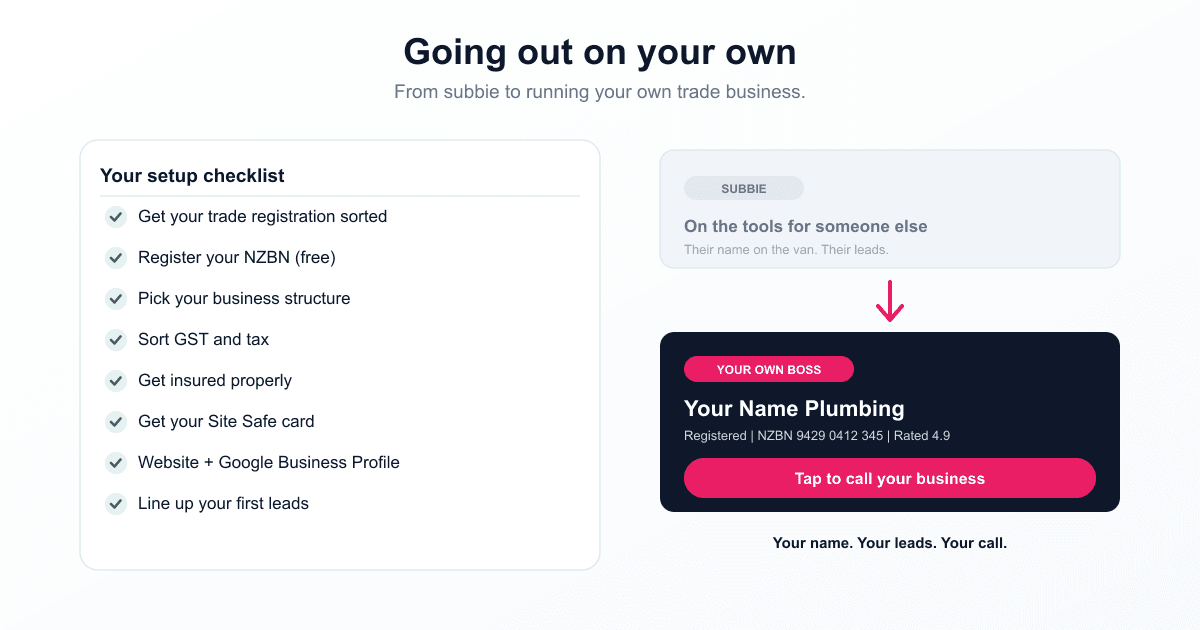
Executive Summary
Key takeaways: what you'll get from this guide
- The full list of what you need to go from subbie to running your own trade business in New Zealand, in the order to do it
- Why your registration comes first, and which body decides whether you even need one
- The honest version of the money side: NZBN, company registration, structure, GST, and what each actually costs
- The insurance you genuinely need, including ACC cover most new tradies get wrong
- What changes the day you take on your first worker
- How your first leads actually come in, and where your website fits
Going out on your own is the best move a lot of tradies ever make. Your name on the van, your leads, your call on which jobs to take. But the jump from being on the tools for someone else to running the whole show means a pile of admin nobody really teaches you. Registration, NZBN, tax, insurance, contracts. Get it sorted properly up front and you start clean. Wing it and you spend your first year fixing things you should have done in week one.
This is the full New Zealand run-through, in the order that makes sense. Work through it top to bottom. Once you are up and running, keep our tradie legal requirements checklist handy for the ongoing obligations, including the marketing and website rules.
Quick heads up. This is a plain-English guide, not legal, tax, or financial advice. The figures are current as of 2026 but fees and thresholds change, so check the official source linked for each step and talk to an accountant about your own situation. A full note sits at the bottom.
Is Going Out on Your Own Actually Worth It?
For most good tradies, yes. You keep the full rate instead of a subbie cut, you pick your jobs, and you build something with your name on it. The trade-off is that the admin, the quiet weeks, and the risk are now yours too. There is no sick pay and no one chasing the invoices but you.
The tradies who do well at it treat the business side as part of the job, not a nuisance. The good news is that the setup below is mostly a one-off. Do it once, properly, and you can get back on the tools.
Action: Before anything else, work out roughly what you need to earn a week to cover your costs and pay yourself. That number tells you how hard the phone needs to ring.
Leave Your Current Gig the Right Way
How you walk out the door matters more than most subbies think. Your old boss, the builders you worked under, and the other subbies are all part of the network that sends you work. Leave well and they refer you. Leave badly and word travels fast in a trade.
A clean exit means:
- Give proper notice and finish the jobs you started. Do not walk off a half-done site.
- Do not poach clients or staff on your way out. If a customer comes to you later on their own, that is fair enough, but actively taking your boss's clients while you are still on their books is a quick way to a bad name and sometimes a legal letter. Check whether anything you signed has a non-compete or non-solicitation clause.
- Sort out the tools. Be clear about what is yours and what belongs to the business, and hand back anything that is not yours.
- Stay on good terms. Your old boss is often your best early source of overflow work. Plenty of new tradies get their first months of jobs from the person they used to work for.
Action: Have the conversation in person, give fair notice, and ask your boss if they would pass on work they cannot take. Most will say yes if you leave well.
Step 1: Get Your Registration Sorted
In New Zealand, whether you need a licence to go out on your own depends entirely on your trade, because unlike a general contractor licence there is no single body covering every trade. Instead, each regulated trade has its own registration board, and for specialist trades there is no small-job exemption at all.
- Electrical. You must be registered with the Electrical Workers Registration Board (EWRB) and hold a current practising licence to carry out or supervise Prescribed Electrical Work, under the Electricity Act 1992 and the Electricity (Safety) Regulations 2010 1. There is no dollar threshold. If you are a sparky, you are licensed from the first job, full stop.
- Plumbing, gasfitting and drainlaying. Restricted work in these trades can only be carried out or supervised by someone registered and licensed with the Plumbers, Gasfitters and Drainlayers Board (PGDB), under the Plumbers, Gasfitters, and Drainlayers Act 2006 2.
- Building, carpentry, roofing and other structural work. The Licensed Building Practitioner (LBP) scheme, run under the Building Act 2004 and administered by MBIE, has required an LBP to carry out or supervise Restricted Building Work (anything affecting the structure or weathertightness of a home) since 1 March 2012 3.
- Everything else (painting, tiling, plastering, fencing, cleaning, lawn-mowing, and most other trades) has no government licensing body. You can start trading the day you are ready, though industry bodies like Master Painters NZ offer voluntary accreditation that customers recognise.
So the move from subbie to your own business is usually the move from working under someone else's registration or supervision to holding your own licence and contracting directly with customers in your own name.
Action: Check which board covers your trade (EWRB, PGDB, or LBP) and confirm you hold the licence level that lets you contract directly, not just do the work under supervision, before you take any job in your own name.
Step 2: Get Your NZBN
An NZBN (New Zealand Business Number) is the 13-digit number that identifies your business, run by MBIE. If you register a company, it is issued automatically on incorporation. If you are staying a sole trader, you can apply for one separately, and it is free for every applicant type 4[5].
Getting an NZBN as a sole trader needs a RealMe login, your IRD number, and some ID. It is not compulsory the way a company's is, but it is worth having early: it goes on invoices, makes you look established, and increasingly some suppliers and platforms expect one.
Action: Apply for your NZBN free through the NZBN website. If you are incorporating a company, you get one automatically as part of that process.
Step 3: Choose Your Business Structure
This is the one worth a chat with an accountant, but here is the plain version.
- Sole trader is the simplest and cheapest. You and the business are the same thing. All the profit is your income, taxed at personal rates, and all the debts are yours personally. Most tradies start here. Setup cost is basically nothing.
- Company is a separate legal entity, so it limits your personal liability for business debts. Registering through the Companies Office costs $10 for name reservation plus $118.74 for incorporation, with a $49.74 annual return fee each year after, all plus GST [6]. Your NZBN is issued automatically the moment you incorporate. The trade-off is more admin: a separate tax return and tighter record keeping.
- Partnership or trust is often used by tradies with a partner or family to split income. It is more complex and really needs an accountant to set up right.
A rough rule: most tradies start as a sole trader and look at a company once the profit is consistently strong, the jobs are getting bigger, or they are taking on staff and want the liability separated. There is no single right answer, which is exactly why this is the step to get advice on.
Action: Start as a sole trader unless an accountant tells you otherwise. You can always move to a company later as the business grows.
Step 4: Register Your Business Name
If you are trading as something other than your own legal name, for example "John Smith Plumbing" rather than just "John Smith", you need that name on your company registration or, for a sole trader, it is worth checking it is not already taken.
If you incorporate a company through the Companies Office, your trading name is part of that same registration covered in Step 3, there is no separate ASIC-style business-name register to pay for on top. Sole traders trading under a name other than their own can register a trademark if they want it properly protected, but this is optional, not a legal requirement to trade.
Action: Pick a name customers will remember and search for, check it is not already registered as a company name on the Companies Office register, and lock it in as part of your incorporation if you are going the company route.
Step 5: Sort Your Tax and GST
As a sole trader you use your own IRD number, and your business income goes in your personal tax return. A company gets its own IRD number.
The one to watch is GST. You must register for GST once your turnover crosses $60,000 in any rolling 12-month period, and you have to do it within 21 working days of becoming liable [7]. Turnover means total income, not profit, so most full-time tradies get there. Once registered, you add 15% GST to your invoices, file a GST return (usually each two months), and you can claim the GST back on your tools, ute, and materials.
You can also register for GST voluntarily before you hit $60,000. It is often worth it, because claiming GST back on a big tool or vehicle purchase adds up.
Action: If you expect to earn over $60,000, register for GST when you set up your IRD details for the business. Put roughly a third of every payment aside for tax and GST so it is there when the return is due.
Step 6: Get Insured Properly
This is where new tradies cut corners and regret it. The cover you actually want:
- Public liability is the big one. It covers you if you damage property or injure someone on the job. Many builders and sites will not let you start without a current certificate.
- Tool and plant insurance covers your gear against theft and damage. Not legally required, but losing a ute full of tools without it ends a lot of new businesses.
- Income protection replaces your income if you are hurt and cannot work. This matters more in New Zealand than most tradies realise, because ACC only covers you up to a point (see Step 8), so a top-up income protection policy is what fills the gap between ACC's payment and your real earnings.
- Home warranty cover. New Zealand has no mandatory statutory home-warranty scheme the way some other countries do. Instead, builders and their customers rely on voluntary guarantees, most commonly the Master Build 10-Year Guarantee (Registered Master Builders) or the Halo 10-Year Guarantee (NZ Certified Builders), on top of the implied warranties already built into the Building Act 2004 [8]. A mandatory scheme has been announced but is not yet law, so do not promise a customer a warranty scheme that does not exist yet, offer one of the voluntary guarantees instead.
Action: Get a public liability quote at the level your jobs require, and if you are a builder, look at whether a Master Build or Halo guarantee is worth offering on bigger residential jobs.
Step 7: Get Your Site Safety Card
If you set foot on most construction sites, you will be asked for a Site Safe Site Safety Card. Unlike some countries' mandatory site-induction cards, this one is not a legal requirement under New Zealand law, but it is an industry-standard expectation, and most principal contractors will not let you on site without it [9].
The card comes from a short course through Site Safe. It is the baseline, not the whole picture. High-risk work like working at height, in trenches, or near live electrical needs its own risk assessment under the Health and Safety at Work Act 2015, and some tasks need their own separate tickets.
Action: If you do not already hold a Site Safety Card, book the course before you line up site work, and check which extra tickets your high-risk tasks require.
Step 8: If You Take On Staff, Sort ACC Levies and KiwiSaver
The day you put on your first worker, two new obligations kick in.
- ACC levies. New Zealand runs a single, national, no-fault injury scheme through ACC, funded by a compulsory Work levy rated on your industry's risk and your payroll [10]. This is a genuinely different system to a state-based workers' compensation scheme: injured workers generally cannot sue, and ACC pays for treatment and up to 80% of lost income instead. As an employer you pay the levy on your payroll; as a sole trader you pay your own levy based on your earnings.
- KiwiSaver. If you take on an employee who is a KiwiSaver member, you must pay a minimum employer contribution of 3.5% of their gross pay from 1 April 2026, stepping up to 4% from 1 April 2028 [11]. This is structurally different to a flat superannuation guarantee: it applies per KiwiSaver member, and you deduct the employee's own contribution on top from their pay. Watch this one closely if you pay a subbie who is really working like an employee, mostly doing your work, on your tools, exclusively for you, because the same contractor-versus-employee scrutiny applies here too.
Action: Before your first worker starts, confirm your ACC Work levy classification and set up a payroll system that handles KiwiSaver deductions and employer contributions correctly from day one.
Step 9: Set Up Your Back Office
The boring stuff that keeps you out of trouble and makes tax time painless.
- Separate business bank account. Not legally required for a sole trader, but do it anyway. It keeps your business and personal money apart and makes GST returns far easier.
- Accounting and invoicing software. Xero (a New Zealand company), MYOB, or QuickBooks all handle invoices, track GST, and help you file your return. For a one-person operation the cheapest tier is usually plenty.
- Proper taxable supply information. Since 1 April 2023, what used to be called a "tax invoice" is now taxable supply information, and the detail required is tiered by value: a minimal amount of detail for supplies of $200 or less, more for $200 to $1,000, and the fullest detail (including the buyer's name and identifier and your GST number) above $1,000 [12]. You must be able to provide it within 28 days of a customer requesting it for anything over $200.
- Written contracts. Even where New Zealand law does not force a written contract for smaller residential jobs, a simple written scope, price, and payment terms protects you far more than a handshake, especially once a job crosses into thousands of dollars. A deposit of around 10% to 20% on bigger jobs is standard practice.
Action: Open a business account, pick one accounting app, and put a simple written contract or quote-acceptance process in place so you are ready before your first big job.
Step 10: Get Found From Day One
You can have every registration and form sorted and still sit by a quiet phone. The last step is making sure customers can find you and choose you. For a new tradie, leads come from four places:
- Google Business Profile. Free, and the single highest-return thing you can set up. It puts you on Google Maps and in the local results when someone searches your trade plus their suburb. Set it up, verify it, add real photos, and start collecting reviews.
- Your own website. This is the asset that turns those searches into calls and that you actually own. Pair it with your Google Business Profile and pages for the suburbs you work in. Two reads worth your time: what a good tradie website looks like and why it has to be mobile first, because most of your customers will find you on a phone, mid-problem, ready to call.
- Word of mouth and reviews. Still the strongest channel early on. Ask every happy customer for a Google review and a referral. Once you are established, see when word of mouth isn't enough for going online without abandoning referrals.
- Lead platforms like Builderscrack. Useful for volume at the start, but you pay for a subscription plan, tokens come off it each time a homeowner accepts your request to connect, and other tradies can be quoting on the same job. Handy to fill gaps, expensive to rely on. The full picture is in our directories guide and local SEO guide.
Action: Set up and verify your Google Business Profile this week, then get a proper website live so the searches it sends you have somewhere to land.
The Order to Do It In
Here is the whole thing as a checklist you can work down.
| # | Step | Where | Rough cost |
|---|---|---|---|
| 1 | Registration (if your trade needs one) | EWRB / PGDB / LBP | Varies by trade |
| 2 | NZBN | nzbn.govt.nz | Free |
| 3 | Business structure | DIY or accountant | $0 sole trader, $178+ company |
| 4 | Business/trading name | Companies Office (part of incorporation) | Included in company fee |
| 5 | Tax + GST registration | IRD | Free |
| 6 | Insurance (public liability, tools, income protection, home warranty) | Insurer / RMBA / NZCB | Varies |
| 7 | Site Safety Card | Site Safe | Course fee |
| 8 | ACC levies + KiwiSaver (if employing) | ACC + your payroll setup | Varies |
| 9 | Bank account, software, contracts | Bank, Xero/MYOB, your own templates | Low monthly |
| 10 | Google Business Profile + website | DIY or M4T | Free GBP, website varies |
Do not let the list scare you. Most of it is a one-off afternoon of admin. Steps 1 to 7 get you legal and covered. Steps 8 to 10 are about running and growing.
Does This Change By Region?
Unlike some countries where a different state body licenses each trade, New Zealand runs its regulated trades under a single national board each: EWRB for electrical, PGDB for plumbing, gasfitting and drainlaying, and LBP for restricted building work, no matter where in the country you work. Your NZBN, GST, KiwiSaver, ACC levies, and Site Safety Card are all national too. There is no separate "Auckland licence" or "Wellington licence" to worry about.
What genuinely does vary by region is demand and competition. Fast-growing areas like Hamilton, Tauranga, and parts of Auckland can support more tradies per suburb, while smaller regional centres like Rotorua or Dunedin reward a tradie who becomes the obvious local choice rather than one of twenty competing for the same search. Either way, the registration and tax rules travel with you.
Action: If you are thinking about which region to base yourself in, weigh up genuine demand and competition rather than any regulatory difference, because for registration and tax purposes New Zealand does not have one.
What Should You Charge?
This is the question that stops most subbies from making the jump. The short version: your charge-out rate has to be a lot more than your old subbie rate, because you now carry everything the business used to cover for you.
As a subbie you got paid for hours worked. As your own business you also cover insurance, tools, the ute, fuel, software, ACC levies, KiwiSaver if you employ anyone, quoting time, quiet weeks, sick days, and tax. Your rate has to soak all of that up and still leave you a wage.
A simple way to think about it:
- Start from what you need to earn, not what the bloke down the road charges. Work out your weekly costs and the wage you want, then divide by the hours you can realistically bill. You cannot bill 40 hours when you are also quoting, driving, and chasing invoices, so plan for billable hours well under your working hours.
- Mark up your materials. You carry the cost and the risk on materials, so a markup, often 10% to 20%, is normal and fair.
- Quote the job, not just the hour, where you can. Customers understand a price for the work better than an hourly rate, and a fixed quote protects your margin if you are quick.
- Do not race to the bottom. The tradie who wins on being cheapest attracts the worst customers and the tightest margins. Win on showing up, doing good work, and being easy to deal with.
- Remember GST. Once you are registered, your prices include 15% GST that was never yours to keep. Quote GST-inclusive so there are no surprises, and set that money aside.
Action: Before your first quote, work out your real hourly cost of being in business, then set a charge-out rate that covers it with a wage on top. Sense-check it against local rates, but lead with your own numbers.
Getting Paid and Staying on Top of Cashflow
Plenty of busy tradies get into trouble not because the work dried up, but because the money came in slower than it went out. Cashflow is what actually sinks new trade businesses, so protect yourself from day one.
- Take a deposit on bigger jobs to cover materials up front. A deposit of around 10% to 20% on residential work is standard practice, so price it accordingly.
- Invoice straight away, the day the job is done, not at the end of the month. The longer you wait, the longer they wait.
- Set clear payment terms in writing before you start, like 7 days, or payment on completion for smaller jobs.
- Make paying easy. Put your bank details and a payment link right on the invoice. The less effort it takes, the faster you get paid.
- Chase late payers early and politely. A friendly reminder the day a payment is overdue gets results. Letting it slide for a month does not.
- Keep tax and ACC money separate. Put aside roughly a third of every payment for tax, GST, and your own ACC levy, so the return and tax bill never catch you out. As a sole trader nobody makes a KiwiSaver contribution for you, so a regular personal contribution is on you, and it comes with the government's own top-up if you make it.
Good accounting software handles most of this for you: automatic invoices, reminders, and a clear view of who owes you what.
Action: Set a standard payment term, put your bank details on every invoice, and send the invoice the day you finish the job.
How M4T Helps With the Last Step
We do not do your registration or your tax, but we own the part most tradies find hardest: getting found. We build mobile-first websites that turn local searches into calls, set up and sharpen your Google Business Profile, and put you on the map for the suburbs you work in. We pull your copy and photos from what you already have, so it costs you a couple of hours, not a couple of weekends.
Going out on your own? Get the registration and tax bits sorted, then let us handle getting found.
New to all this? Start with what a good tradie website looks like. Plan quotes@yourdomain early, not a personal Gmail inbox on invoices (business email for tradies).
Want a Hand Getting Found From Day One?
You sort the registration, the NZBN, and the insurance. We will make sure customers can actually find you the moment you are ready to take work.
- Book a quick call. Tell us your trade and where you work. We will give you a straight plan to get found, no pitch, no obligation.
- Free website audit. Already have a site or a profile? We will check it and send you a PDF on what is working and what is costing you calls within 24 hours.
Frequently Asked Questions
Do I need a licence to start my own trade business in New Zealand?
It depends on your trade. Electricians must be registered with the EWRB, plumbers, gasfitters and drainlayers with the PGDB, and anyone doing Restricted Building Work needs an LBP licence. There is no dollar threshold for these, you are licensed from the first job. Most other trades, like painting, tiling, or lawn-mowing, have no government licensing body at all, though industry associations offer voluntary accreditation.
How much does it cost to start a trade business in New Zealand?
The core registrations are cheap. An NZBN is free, and if you incorporate a company it costs around $10 for name reservation plus $118.74 for incorporation, with a $49.74 annual return fee, all plus GST. The real costs are your trade registration if applicable, insurance such as public liability, and your tools and vehicle. Budget for those as your main upfront spend.
Should I be a sole trader or a company?
Most tradies start as a sole trader because it is the simplest and cheapest, with your business income taxed at personal rates. A company limits your personal liability and gets its own NZBN automatically on incorporation, but costs more to set up and run. The usual trigger to switch is when your profit is consistently strong, your jobs get bigger, or you take on staff. It is the one decision worth getting an accountant's advice on.
Do I need to register for GST as a tradie?
You must register for GST once your turnover reaches $60,000 in any rolling 12-month period, which most full-time tradies hit, and you have 21 working days to do it once you know you will cross the threshold. Turnover is total income, not profit. You can also register voluntarily before then, which lets you claim the GST back on tools, your ute, and materials. Once registered you add 15% GST to invoices and file a GST return, usually every two months.
What insurance do I need as a tradie going out on my own?
Public liability is the must-have, and many builders and sites will not let you start without it. Tool insurance protects your gear, and income protection tops up what ACC pays if you are hurt, since ACC only covers a portion of lost income. New Zealand has no mandatory home-warranty scheme, but builders commonly offer the voluntary Master Build 10-Year or Halo 10-Year guarantee on residential jobs. If you employ anyone, you need to sort ACC Work levies and KiwiSaver.
How do I get my first customers when I go out on my own?
Message builders and your old boss before you leave, then verify your Google Business Profile and ask for reviews on every job. Add a simple mobile-first website within the first month. Lead platforms like Builderscrack can fill gaps but work best alongside your own listing and site, not instead of them.
Does anything change by region in New Zealand?
Not for registration or tax. EWRB, PGDB, and LBP are single national bodies, and your NZBN, GST, ACC levies, and KiwiSaver rules apply the same whether you are in Auckland, Christchurch, Hawke's Bay, or anywhere else. What changes by region is demand and competition, which is worth weighing up, but it is a business decision, not a legal one.
What should I charge when I go out on my own?
Your charge-out rate needs to be well above your old subbie rate, because you now cover insurance, tools, the ute, ACC levies, quoting time, quiet weeks, and tax on top of your wage. Start from what you need to earn, not what others charge: work out your weekly costs and target wage, then divide by the hours you can realistically bill. Add a markup on materials, quote the job rather than the hour where you can, keep prices GST-inclusive, and avoid winning work just by being the cheapest.
How do I make sure I get paid on time?
Cashflow sinks more new trade businesses than a lack of work does. Take a deposit on bigger jobs, typically 10% to 20%, invoice the day you finish rather than at month end, and set clear payment terms in writing before you start, like 7 days. Put your bank details and a payment link on the invoice to make paying easy, chase late payments politely the day they are overdue, and set aside about a third of every payment for tax, GST, and your ACC levy.
References:
- [1] Electrical Workers Registration Board (EWRB), Prescribed Electrical Work (registration and licensing requirement)
- [2] Plumbers, Gasfitters and Drainlayers Board (PGDB), registration and restricted work
- [3] Licensed Building Practitioners (LBP) scheme, Ministry of Business, Innovation and Employment (Restricted Building Work since 1 March 2012)
- [4] NZBN, Get an NZBN if you're self-employed or a sole trader
- [5] NZBN, Applying for an NZBN (free for all applicant types)
- [6] Companies Office, Incorporating a company (fees for reservation, incorporation, and annual return)
- [7] Inland Revenue (IRD), Registering for GST ($60,000 threshold, 21 working days)
- [8] interest.co.nz, coverage of the proposed mandatory home-warranty scheme (not yet law) and the current voluntary Master Build / Halo guarantees
- [9] Site Safe, Site Safety Card (industry-standard, not a legal requirement)
- [10] ACC, Understanding levies if you work or own a business (Work levy, no-fault cover)
- [11] Inland Revenue (IRD), Employer contributions to KiwiSaver (3.5% from 1 April 2026, rising to 4% from 1 April 2028)
- [12] Inland Revenue (IRD), How taxable supply information works (tiered detail requirements since 1 April 2023)
This guide is general information for New Zealand tradies, current as of 2026. It is not legal, tax, financial, or insurance advice. Fees, thresholds, and rules change, and your situation is your own, so confirm the current details with the official source linked for each step and speak to a licensed accountant or adviser before you act.
Published by Made 4 Tradies. Kiwi-owned, run by a Hawke's Bay local. Serving Auckland, Christchurch, Hamilton, and nationwide.
Talk To A Real Person
Want us to look at your site and tell you straight?
Book a quick call and we'll tell you what's working, what's costing you calls, and what to fix first. No pitch, no obligation.
A straight read on your website from people who build them for tradies every day.
Book a quick call →Prefer it in writing? Free website audit →