
Local SEO · Tradies · Suburb Pages
Suburb Pages: Why Tradies Need Them and How to Build Them
Executive Summary
Key takeaways, what you'll get from this guide
- Why "plumber Auckland" is unwinnable but "plumber Henderson" is very achievable with the right page
- The exact elements every suburb landing page needs (and the three things that make Google ignore thin clones)
- How to choose which suburbs to target first based on where you actually work and where the search volume is
- How suburb pages connect to your Google Business Profile, reviews, and directory listings
- A practical build order: start with 5 suburbs, expand only when each page has genuine local content
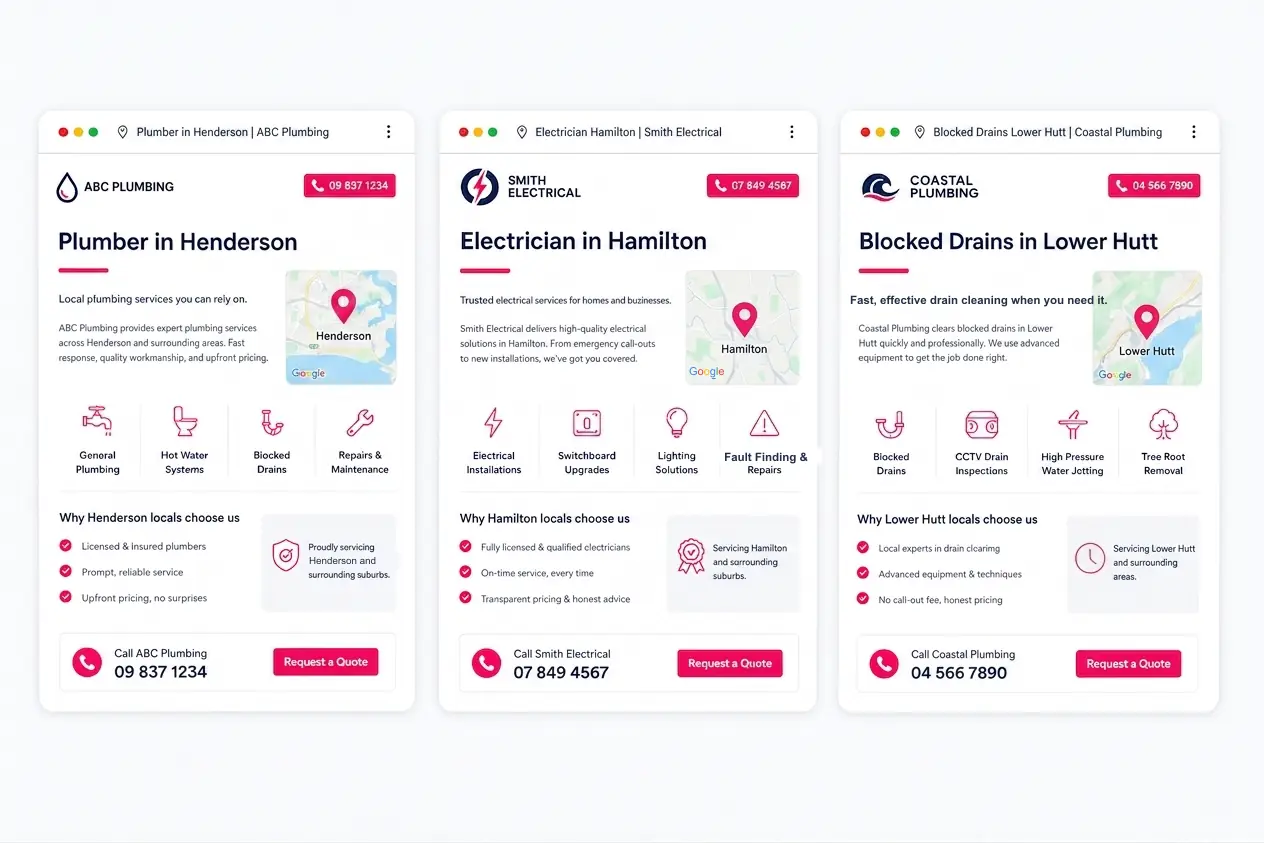
A suburb landing page is a dedicated page on your tradie website targeting one specific location you service, for example, a page built to rank for "electrician Manukau" or "blocked drains Albany". It is not your homepage with the suburb name swapped in. It is a focused page with local copy, your registration or licence number, proof you work in that area, and a clear way to call or request a quote.
Most tradies either have no suburb pages at all, or 30 identical templates with only the suburb name changed. Both leave money on the table. The first means you never rank for the high-intent searches that actually convert. The second means Google treats the lot as duplicate content and ranks none of them.
A few numbers that explain why this page type matters:
46% of all Google searches have local intent, the searcher wants a business near them 1.
"Near me" and suburb-specific searches convert at roughly 3× the rate of generic trade searches because the customer already knows what they need 2.
Businesses with location-specific landing pages capture long-tail traffic that broad homepage SEO cannot reach 3.
Tradies ranking in the Google Maps 3-pack for suburb searches typically have both an optimised Google Business Profile and matching suburb content on their website 4.
This guide is the tactical deep-dive. For the full local SEO picture (GBP, directories, reviews, AI search), see our complete local SEO guide for tradies.
Why Can't I Just Rank My Homepage for Every Suburb?
Your homepage has one job: tell Google and customers who you are, what you do, and where you broadly operate. It cannot realistically target 20 different suburbs with equal depth.
When someone searches "plumber Henderson", Google looks for the page that best matches that query. A homepage titled "West Auckland Plumber | ABC Plumbing" is a weak match. A dedicated page titled "Plumber Henderson | Emergency & Residential | ABC Plumbing" is a strong one.
The maths is straightforward. "Plumber Auckland" has enormous search volume and enormous competition. "Plumber Henderson", "Plumber Albany", and "Plumber Papakura" each have lower volume individually, but the combined traffic from 10–15 suburb pages often exceeds what a homepage alone can capture, with far less competition per keyword. For how to choose those phrases in the first place, see what keywords a local tradie should target.
Action: List the 10 suburbs where you complete the most jobs. Those are your first suburb page candidates.
What Is the Difference Between a Service Page and a Suburb Page?
Tradie websites often confuse these. Both matter, but they target different searches.
| Page type | Example search | What it answers |
|---|---|---|
| Service page | "hot water system replacement cost" | What the service involves, pricing signals, process |
| Suburb page | "plumber Henderson" | Who serves this area, how fast you respond, local proof |
| Service + suburb page | "hot water Henderson" | Both, ideal for high-value services in specific areas |
A minimum viable tradie site has a strong homepage, individual service pages, and suburb pages for your core areas. M4T client sites typically include all three from launch. The hero on a well-built tradie site names the suburb or region in the first screen, not buried in the footer.
How Do I Choose Which Suburbs to Build Pages For?
Start with evidence, not guesswork.
Where you actually work
Build pages for suburbs where you have completed jobs in the last 12 months. Google and customers both spot a tradie claiming coverage they do not genuinely provide. If you have never worked in Papakura, do not build a Papakura page yet.
Where your reviews mention you
Check your Google reviews for suburb names. "Fixed our blocked drain in Albany, legend" is a signal you should have an Albany page that references drain work. Reviews with geography help both your Maps ranking and your website relevance.
Where search demand meets your capacity
Use Google Search Console (free) to see which suburb + trade queries already bring impressions to your site. Build or improve pages for queries where you appear on page 2 or 3, those are the fastest wins.
Match your Google Business Profile service area
The suburbs listed in your Google Business Profile service area should align with your suburb pages. Mismatch creates confusion for Google and for customers. If your GBP lists Henderson but you have no Henderson page, you are leaving a ranking signal on the table.
Practical target: 5 suburb pages to start. Expand to 10–15 once each page has unique content. Avoid launching 30 thin pages on day one.
What Must Every Suburb Landing Page Include?
Use this as your build checklist. Every item matters for rankings, trust, and conversions.
1. Trade + suburb in title tag, H1, and first paragraph
Title: Plumber Henderson | Emergency & Residential | ABC Plumbing
H1: Your Local Plumber in Henderson
First paragraph: "ABC Plumbing has serviced Henderson, Te Atatu, New Lynn, and Massey for 15 years..."
Google reads the title tag first. The H1 confirms the topic. The first paragraph should name the suburb naturally within the first 100 words.
2. Your registration or licence number
Depending on your trade, displaying your registration when advertising services is a legal requirement, EWRB for electricians, PGDB for plumbers, gasfitters and drainlayers, or LBP for restricted building work. A suburb page is an advertisement. Include your registration or licence number in the page footer or a visible trust block, same format as your GBP and directory listings.
3. Specific suburbs and neighbourhoods, not just the region name
"West Auckland" alone is thin. "Henderson, Te Atatu, New Lynn, and Massey" shows genuine local knowledge.
4. Services relevant to that area
If you do emergency callouts, say so. If you specialise in older villas in established suburbs, mention it. One or two sentences about what you commonly fix in that area beats a generic service list copied from your homepage.
5. Local social proof
A review quote that mentions the suburb. A before-and-after photo from a job in that area. "Recently completed a hot water install in Manukau", specific beats generic every time.
6. Phone number and click-to-call above the fold
Suburb searches are often urgent. Mobile users should be one tap from calling. Repeat the number in the page footer for consistency with your NAP (Name, Address, Phone) across the site.
7. Contact form or quote request
Not every visitor calls. A short form ("Suburb", "Service needed", "Phone") captures leads from people browsing at night.
8. Internal links
Link to your main service pages ("See our blocked drain service"). Link to neighbouring suburb pages where relevant. Internal linking helps Google understand your site structure and passes authority between pages.
9. LocalBusiness or Service schema markup
JSON-LD schema telling Google your business name, address, phone, service area, and the services you offer on this page. It helps Google understand the page 5, but it isn't a shortcut into AI search: Google says there's no special markup to add for AI Overviews or AI Mode 6.
What Makes Google Ignore or Penalise Suburb Pages?
Google's helpful content systems are specifically designed to catch location pages that exist only to manipulate rankings.
Thin duplicate templates
If the only difference between /plumber-henderson and /plumber-manukau is the suburb name in three places, Google will treat them as doorway pages. Doorway pages violate Google's spam policies and can hurt your whole site.
Fix: Each page needs at least 300–400 words of unique copy. Mention different neighbourhoods, different job types, or different local context per page.
Suburbs you do not genuinely serve
Claiming 50 suburbs across three regions when you are a one-van operation in one district destroys trust with Google and with customers who call expecting a fast response.
No supporting signals
A suburb page with no reviews from that area, no GBP service area entry, and no directory citations mentioning that suburb is an orphan. Google cross-checks your website claims against your GBP, reviews, and citations. Align all three.
Missing mobile performance
Most suburb searches happen on mobile. If your suburb pages load slowly or have layout shift on a phone, rankings suffer regardless of copy quality. Run PageSpeed Insights on each template before publishing at scale.
How Do Suburb Pages Work With Google Business Profile and Reviews?
Suburb pages are not a replacement for your GBP. They reinforce it.
Google Business Profile determines whether you appear in the Maps 3-pack for suburb searches. Your website suburb pages give Google additional relevance signals when someone clicks through or when Google crawls your site.
Reviews that mention suburbs are particularly powerful. A review saying "Best sparky in Manukau, turned up same day" helps your Manukau ranking in Maps and validates your Manukau page content. See our Google reviews guide for how to ask without breaking Google's rules.
Directory listings with consistent suburb coverage (Yellow, NoCowboys, etc.) add citations that support both your GBP and your website. Our New Zealand directories guide covers the free listings worth your time.
How Many Suburb Pages Should a Tradie Have?
There is no magic number. Use this framework:
| Stage | Suburbs | When |
|---|---|---|
| Launch | 3–5 | Your highest-volume areas with real job history |
| Growth | 8–15 | After each initial page has unique content and at least one local proof point |
| Mature | 15–25 | When you have review volume and job photos across multiple areas |
More is not always better. Fifteen strong suburb pages outperform forty thin ones. Expand when you can add something genuinely different to each new page, not when you want to tick a box.
Can I Build Suburb Pages Myself or Should I Get Help?
DIY works if you are comfortable writing unique copy for each suburb, updating title tags and meta descriptions, and adding schema markup. Expect 2–4 hours per page when done properly, not 20 minutes of find-and-replace.
DIY falls short when you need pages at scale (10+), technical SEO (schema, Core Web Vitals, internal linking architecture), or a CMS that lets you edit pages without breaking the layout.
Made 4 Tradies builds suburb pages into every client website as standard, not as a bolt-on. Each page includes location-specific titles, registration or licence display, schema markup, mobile-first layout, and a structure Google and AI crawlers can parse. See pricing for build options or portfolio for examples.
How Does Made 4 Tradies Build Suburb Pages?
Every M4T website includes a suburb page architecture designed for local search from day one:
- Unique title tags and meta descriptions per suburb, trade, location, and business name baked in
- Registration or licence number visible on every page footer
- LocalBusiness + Service schema on each suburb and service page
- Internal linking between suburbs, services, and the homepage
- Mobile-first layout with click-to-call prominent on every suburb page
.mdcopies and anllms.txtfile, extras aimed at other AI tools (Google says you don't need either to appear in Google Search 7)
If you already have a website but no suburb pages, a targeted rebuild often pays for itself within a few booked jobs from suburb-specific search traffic.
Want Someone to Review Your Suburb Page Setup?
Made 4 Tradies offers free, no-obligation audits for New Zealand trade businesses. We will tell you straight whether your current site can rank for suburb searches or what is holding it back.
- Free website audit, SEO structure, suburb page gaps, schema, speed, conversion blockers. PDF in 24 hours.
- Free Google listing audit, Maps ranking, service area setup, review profile, competitor comparison. PDF in 24 hours.
No call required. No pitch. Just a straight read on what is costing you work.
Frequently Asked Questions
Do suburb pages actually work for tradies in 2026?
Yes. Suburb-specific searches remain one of the highest-converting local search types. The tradies who rank for them typically have dedicated pages with genuine local content, a matching Google Business Profile service area, and reviews that mention those suburbs, not just a homepage claiming broad coverage.
How long does it take for a new suburb page to rank?
Expect 6–12 weeks to see meaningful movement for a competitive suburb, faster for lower-competition areas. Pages on established domains with existing local authority rank quicker than brand-new sites. Pair every new page with a Google listing service area update and ask for reviews from jobs in that suburb. For the full channel-by-channel timeline (listing, website, reviews, and suburbs), see how long SEO actually takes for a tradie.
Can I copy my homepage and change the suburb name?
No. That creates thin duplicate content Google classifies as doorway pages. Each suburb page needs unique copy: different neighbourhoods named, different services emphasised, local proof (reviews, job photos) where possible. At minimum, 300–400 words that a human would recognise as written for that specific area.
Should I build suburb pages or service pages first?
Service pages first if you have neither. Customers search both ways ("plumber Henderson" and "hot water replacement cost"). Sensible order: homepage, 3–5 core service pages, then 5 suburb pages for your busiest areas. For the full decision table and why suburbs-only or services-only fails, see Service Pages vs Suburb Pages in our local SEO guide.
Do I need a separate suburb page for every suburb I list on Google Business Profile?
Not necessarily one-for-one, but major suburbs in your GBP service area should have a matching page or a clearly dedicated section on a regional page. If Henderson is in your GBP service area and you get regular Henderson jobs, you need Henderson content on your site.
Will suburb pages hurt my homepage rankings?
No. Suburb pages target different keywords than your homepage. Done correctly, they strengthen your overall site authority by adding relevant, internally linked content. The risk is thin duplicate pages, quality suburb pages help the whole site.
How much content does each suburb page need?
Aim for 400–600 words of unique body copy plus your standard trust elements (registration or licence, phone, reviews, CTA). Shorter can work for low-competition suburbs. Never publish a page with only 100 words and a contact form.
References:
- [1] Google Search Central, Local business (LocalBusiness) structured data
- [2] BrightLocal, Local Consumer Review Survey
- [3] BrightLocal, What Is Local SEO? (location pages guide)
- [4] Google Business Profile Help, How local ranking works
- [5] Google Search Central, Intro to How Structured Data Markup Works
- [6] Google Search Central, AI Features and Your Website
- [7] Google Search Central, guide to generative AI features on Google Search
Published by Made 4 Tradies. Kiwi-owned, run by a Hawke's Bay local. Serving Auckland, Wellington, Christchurch, and nationwide.
Free Website Audit
See exactly what your website is costing you.
Send us your web address and a real person checks the lot: how fast it loads on a phone, whether you turn up in local searches, and what is stopping visitors picking up the phone. You get a PDF with specific issues, specific fixes, ranked by impact.
No call. No pitch. No obligation. Turnaround within 24 hours.
Get my free website audit →